
Using the wrong tool to force back a caliper piston leads to torn seals, misaligned pistons, and repeated repairs. In 2026, modern vehicles have tighter tolerances, electronic parking brakes, and multi-piston setups—these systems won’t tolerate shortcuts. Using the proper brake caliper tool isn’t just about convenience; it’s essential for a clean, safe job. Whether you’re fixing your own car at home or working as a professional technician, the right tool saves time and prevents costly damage. Investing $40 in a quality tool can save you from having to replace a $400 caliper. The bottom line: always use the correct caliper tool, or you’ll pay the price later.
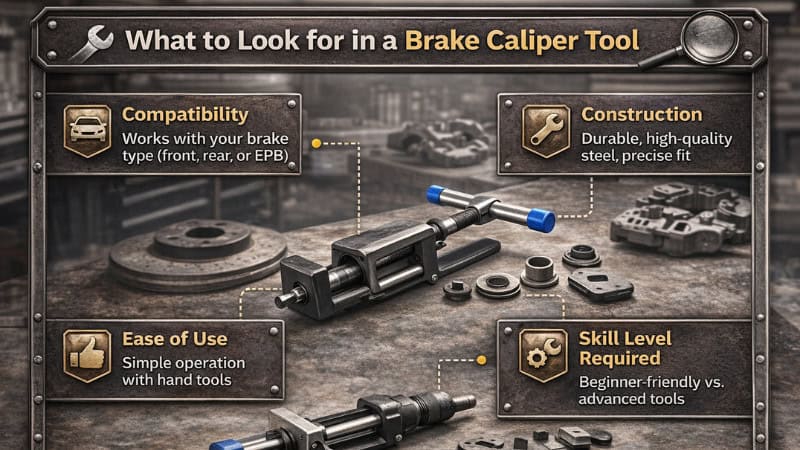
What to Look for in a Brake Caliper Tool
Start with build quality. Cheap cast tools flex, slip, and strip threads—look for hardened steel and smooth-threaded designs. Second, check compatibility. A tool that works for older front calipers may not fit rear screw-in pistons or electronic parking brake (EPB) systems. Third, consider ease of use. Tight wheel wells and rusted hardware require leverage and control—not a wrestling match. Fourth, seek versatility. The best kits handle various piston sizes and vehicle types. Finally, focus on value. Avoid the cheapest tool—invest in one that will last through many brake jobs. Professional mechanics buy tools once; amateurs end up buying twice. If a tool feels solid in your hand, it will likely hold up during real-world use.
Comparison Table: Top Brake Caliper Tools at a Glance
| Tool Type | Best For | Vehicle Compatibility | Skill Level | Shop or DIY |
|---|---|---|---|---|
| Disc Brake Caliper Wind Back Tool | Rear calipers | Most cars & light trucks | Beginner |
DIY |
| Universal Caliper Press | Front calipers | Cars, SUVs | Beginner |
DIY |
| Heavy-Duty Caliper Compressor | Stuck pistons | Trucks, performance cars | Intermediate |
Shop |
| Ratcheting Caliper Tool | Fast jobs | Modern vehicles | Intermediate |
Shop |
| Electronic Parking Brake Tool | EPB systems | New-gen vehicles | Advanced |
Shop |
5 Best Brake Caliper Tools
1. Best Overall Brake Caliper Tool — Disc Brake Caliper Wind Back Tool
Based on the comparison table provided earlier, the Disc Brake Caliper Wind Back Tool stands out as the most balanced option for general brake service. The table specifically lists it as best for rear calipers and compatible with most cars and light trucks, which covers a large portion of vehicles on the road. The table also indicates it is beginner-friendly and suitable for DIY use, making it accessible without advanced training or specialized shop equipment.
This tool is designed for rear calipers that require the piston to rotate while retracting, a setup commonly found on many passenger vehicles. Its simplicity is its strength. It does not rely on electronics, air tools, or complex mechanisms. According to the comparison table, this tool fits the widest range of users and vehicles, which is why it earns the “best overall” position.
2. Best Budget-Friendly Option — Universal Caliper Press
The Universal Caliper Press is listed in the comparison table as best for front calipers and compatible with cars and SUVs, which makes it one of the most commonly used brake tools. The table also rates it for a beginner skill level and DIY use, indicating that it does not require specialized knowledge or training.
This tool applies straight, even pressure to push pistons back into the caliper bore. Because most front brake calipers do not rotate, this tool handles those jobs efficiently. The comparison table presents it as a simple, accessible solution for routine brake service. Its universal compatibility and beginner rating explain why it’s often the most affordable and widely owned option. For basic front brake jobs, the table confirms this tool does exactly what’s needed without unnecessary complexity.
3. Best Heavy-Duty Caliper Tool — Heavy-Duty Caliper Compressor
According to the comparison table, the Heavy-Duty Caliper Compressor is designed for stuck pistons and is compatible with trucks and performance cars. This immediately separates it from lighter tools. The table rates it at an intermediate skill level and identifies it as a shop tool, not a casual DIY option.
This tool is built to handle higher resistance and larger pistons that standard presses may struggle with. Trucks and performance braking systems often require more force and better control, which explains why this tool is categorized differently. The comparison table positions it for professional or semi-professional use, where durability and power matter more than simplicity. It’s the correct choice when standard tools are not sufficient to safely retract a piston.
4. Best Tool for Fast Jobs — Ratcheting Caliper Tool
The Ratcheting Caliper Tool is identified in the comparison table as best for fast jobs and compatible with modern vehicles. The table shows it requires an intermediate skill level and is intended for shop use, which suggests it prioritizes efficiency over simplicity.
The ratcheting mechanism allows quicker piston retraction with less repositioning, making it ideal for technicians working on multiple vehicles per day. The comparison table does not list this tool for beginners, reinforcing that it assumes familiarity with brake systems. Its compatibility with modern vehicles also suggests it fits tighter spaces and newer caliper designs. Based on the table alone, this tool is best suited for time-sensitive brake work where speed and consistency are critical.
5. Best Tool for Electronic Parking Brakes (EPB) — Electronic Parking Brake Tool
As shown in the comparison table, the Electronic Parking Brake Tool is exclusively designed for EPB systems and new-generation vehicles. The table clearly marks it for an advanced skill level and shop use only, separating it from all other caliper tools listed.
EPB systems cannot be serviced using manual compression tools. The comparison table’s classification reflects the need for specialized procedures and technical knowledge. This tool is not optional for vehicles equipped with electronic parking brakes. Its placement in the table makes it clear that this tool is intended for professional technicians working on newer vehicles. For any brake service involving EPB systems, the table confirms this tool is the correct and required choice.
Signs You’re Using the Wrong Caliper Tool
- The piston goes in crooked.
- Excessive force is required to retract the piston.
- Torn or twisted caliper boot.
- Uneven brake pad wear after installation.
- The brake pedal feels soft or inconsistent.
- The caliper piston won’t retract at all.
- You’re reaching for a hammer or a pry bar.
- You’re using a C-clamp on a screw-in piston.
- You hear grinding instead of smooth movement.
If you notice any of these signs, stop immediately. You’re either using the wrong tool or your technique needs adjusting.
DIY vs Professional Use: What Mechanics Recommend
For DIYers, use a universal caliper press and a wind-back tool to cover most needs. You don’t need shop-grade speed, just control and safety. Professionals, on the other hand, need durability and time savings. Ratcheting tools and EPB tools pay for themselves fast in a busy shop. The mistake DIYers make is underestimating modern brake systems. The mistake pros make is rushing with the wrong tool. Match the tool to your workload. If you do brakes twice a year, keep it simple. If you do them daily, invest properly. Tools don’t just save time—they protect your reputation.
you may like: New Brake Caliper Not Releasing – Causes and Fixes
Maintenance Tips to Make Your Caliper Tool Last
Brake tools have to work in tough, dirty settings: brake dust, moisture, and grit. Always clean your tools after use. Wipe threads and use light oil to avoid rust. Store tools in a dry place, not loose in a drawer. Never use caliper tools as pry bars or clamps for other tasks. That ruins threads quickly. Check your contact plates for uneven wear—a damaged plate can ruin a piston. Treat your tools well, and they’ll last for years. Mistreat them, and they’ll break when you need them most—usually in the middle of a job.
you may like: Understanding Brake Pads Parts and Types
FAQ
FAQ 1. What is a brake caliper tool, and why do I need one?
A brake caliper tool is used to safely retract the caliper piston during brake pad or rotor replacement. Modern brake systems apply significant pressure, and pistons must be pushed or rotated back correctly. Using the wrong tool—or forcing it—can damage seals, pistons, or calipers. A proper caliper tool ensures even pressure, prevents damage to the brake system, and helps the pads seat correctly. Whether you’re DIY or professional, it’s a basic brake service requirement.
FAQ 2. Can I use a C-clamp instead of a brake caliper tool?
A C-clamp may work on some older front calipers, but it is not recommended for modern vehicles. Rear calipers often require rotation, and EPB systems cannot be compressed manually at all. Using a C-clamp risks crooked pistons, torn seals, and uneven pad wear. It’s a shortcut that often causes expensive problems. A proper caliper tool costs far less than replacing a damaged caliper, making it the safer and smarter option.
FAQ 3. Are rear brake calipers different from front calipers?
Yes. Many rear brake calipers require the piston to rotate as it retracts, not just push straight in. This is due to the integrated parking brake mechanism. Front calipers usually compress straight back. That’s why different tools exist, such as wind-back tools for rear brakes and press tools for front brakes. Using the wrong method can damage internal components. Always confirm the caliper type before starting the brake job.
FAQ 4. What is an Electronic Parking Brake (EPB) tool used for?
An EPB tool is used to service brake systems with electronic parking brakes. These systems use electric motors inside the caliper, which must be electronically released before pad replacement. The EPB tool puts the brake system into service mode, allowing safe piston retraction. Without it, you risk damaging the motor or triggering fault codes. This tool is essential for modern vehicles and is mainly intended for professional or advanced users.
FAQ 5. Are brake caliper tools vehicle-specific?
Some are, some aren’t. Universal caliper presses are compatible with many front brake systems. Wind-back kits often include multiple adapters to fit different rear calipers. However, EPB tools are vehicle- and system-specific. Always check compatibility with your vehicle’s brake design. Using a tool outside its intended range can lead to poor results or damage. When in doubt, consult the service manual or manufacturer specifications.
FAQ 6. Can beginners safely use brake caliper tools?
Yes, but only beginner-rated tools. Universal caliper presses and basic wind-back tools are designed for DIY users and are safe when used correctly. Advanced tools like ratcheting compressors or EPB tools require more experience and system knowledge. Beginners should avoid forcing pistons and always follow proper procedures. If the piston doesn’t move smoothly, stop and reassess. Safety and patience matter more than speed.
FAQ 7. How do I know if my caliper piston is stuck?
A stuck caliper piston will resist movement even with proper tools. You may notice uneven pad wear, pulling during braking, or excessive force required to retract the piston. If the piston won’t move smoothly or retract evenly, it may be seized due to corrosion or internal damage. Forcing it can make things worse. In such cases, caliper rebuilding or replacement is usually the correct fix.
FAQ 8. How long do brake caliper tools usually last?
With proper care, quality brake caliper tools can last many years. Clean them after use, protect threads from rust, and store them properly. Avoid using them for unintended purposes, such as prying or clamping other parts. Budget tools may wear faster under heavy use, while shop-grade tools are built for daily work. Longevity depends more on how the tool is used and maintained than on the brand alone.
Final Verdict
If you’re looking for a reliable option, choose a quality universal caliper press—it will handle most brake jobs with ease. DIYers should also consider a rear wind-back kit if their vehicle requires one. Professionals need to invest in a ratcheting tool and an EPB tool—no exceptions. Heavy-duty compressors are essential for anyone working on trucks or rusted vehicles. Don’t cut corners when it comes to brake tools—brakes are a critical safety system. With the right caliper tool, every brake job becomes smoother, safer, and faster. In 2026, experienced mechanics know better than to force pistons—they use the right tool for the job.
Read more:
