
Shopping for the best 4-post car lift in 2026 isn’t about flashy marketing—it’s about reliability and strength. A 4-post lift is ideal for storage and stability. With the right accessories, it handles real maintenance. Many lifts look similar online, but real differences appear after installation: sticky locks, wobbly runways, uneven cables, or poor customer support. This guide breaks down the 10 best lifts with clear reviews, top uses, pitfalls, and tips for choosing the right one.
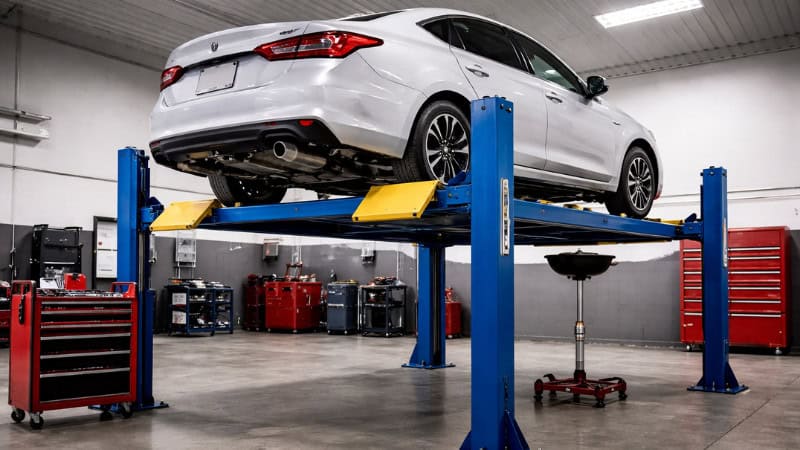
Our Top Picks
If you want a quick answer, here’s how US garages and shops can choose a 4-post lift. Best Overall has a true 8,000–9,000 lb capacity, strong locks, and stable runways. Best Value has solid steel, reliable hydraulics, and a decent warranty—without extras. Best Heavy-Duty meets truck or shop needs: 12,000–14,000 lb capacity, long runways, and level cables. Let’s review all ten lifts using this structure.

Best Overall: BendPak HD-9XW
For shop-grade stability in a home garage, the BendPak HD-9XW features a reinforced platform engineered for daily use without flex, and its 100-inch width accommodates full-size trucks and wide cars. Its mechanical locks engage positively and evenly, ensuring secure lifts. It requires a solid, level concrete base, and once in place, it offers precise operation. The main drawback: its higher price and additional accessory costs quickly add up.
Best Value: APlusLift HW-10KOH
The APlusLift HW-10KOH, ideal for home mechanics and small shops, delivers an actual 10,000-lb capacity—safely lifting most half-ton trucks and SUVs. It includes anchor hardware and pads, and features dependable steel arms and a robust hydraulic system. Its affordability stands out, but setup is slower, and the fit and finish are less refined than BendPak’s.
Best Heavy-Duty: BendPak HD-14X
If you lift heavy trucks, work vans, or run demanding shop cycles, you need maximum capacity. The BendPak HD-14X, a 14,000-lb lift, is engineered for heavy use and durability. Its dimensions support service accessories, not just storage. Thick runways and robust hardware minimize flex, ensure stable lifts, and provide secure locking. This is ideal for service expansions. The main trade-offs are a higher price, the need for more floor space, and a more complex installation. You will need to plan carefully for space, power, and concrete requirements before purchase to avoid installation issues or outgrowing your workspace.
Best for Long Wheelbase Trucks: Atlas Platinum PVL-12
Long-wheelbase vehicles often outgrow standard 4-post lifts. The 12,000-lb Atlas Platinum PVL-12 suits crew-cab pickups, extended SUVs, and vans, providing vital capacity and extended stability on the runway. Its longer platform reduces parking guesswork and aids in precise positioning. For tasks beyond storage, the extra space makes it easier to use jacking accessories. The main trade-off is the larger space requirement, which means you need a bigger garage, and shipping and installation can be more involved due to the lift’s size and weight.
Best Budget: Tuxedo 4-Post
If you’re on a tight budget but want a genuine 4-post lift, the Tuxedo 8,000–9,000-lb model is designed for home mechanics. It includes drive-on runways, automatic safety locks, and a rated capacity for most daily drivers, providing storage or light service capability. This lift requires proper installation and careful leveling. The main trade-offs are a longer setup time, simpler hardware that may not feel as refined, and customer support that can vary. It’s a smart buy if you expect some limits in finish and support in exchange for the lower price.
Best Premium: Rotary 4-Post Lift
If you dislike buying tools twice, the Rotary 4-post offers industrial-grade durability and reliability for constant shop use. Expect smooth, consistent lifting, positive locking mechanisms, hardware that holds its settings, and responsive parts support. For commercial shops, this means reduced downtime and increased productivity. The lift maintains alignment under heavy loads, ideal for frequent truck service. The explicit trade-offs are a higher initial cost and the need to budget for freight and installation. Be prepared to invest upfront and spend time managing delivery and setup, but you gain reliability and longevity in daily shop use.
Buyer’s Guide
Choose a 4-post lift like a toolbox: focus on what you’ll use, not just specs. Start with capacity—ensure it fits your heaviest vehicle with a margin of error. Next, check runway length and width—a “12,000 lb” lift is pointless if your truck barely fits. Consider lock and cable design. Good locks work smoothly; well-routed cables keep your lift level. Finally, factor in ceiling height, power (110V or 220V), and concrete quality. If these aren’t right, even the best lift causes problems. Stacking two cars depends on clear measurements, not hope.
Consider where the posts will sit. Ensure doors can open, there’s room to walk, and you have clearance to drive on without hitting a post. If space is tight, choose a lift that matches your vehicles—don’t pick a huge lift that fills your garage.
you may like: How To Use a Car Lift
Installation Basics
Most 4-post lift problems arise from installation, not from the lift itself. Begin with a solid, level concrete floor. If your slab is thin, cracked, or uneven, you’ll struggle to level the lift, and the locks may not function properly. Set up the lift in its intended location—consider door clearance, toolbox placement, and straightforward vehicle access. A technically installed lift that frustrates you every time does not provide a satisfactory solution.
When you assemble the lift, take your time with the cables. Bad cable routing or adjustment can make one side rise faster, make the lift feel crooked, or affect the locks. After a few uses, recheck everything—tighten hardware, adjust cables, and check locks. Do regular checks, as with any shop equipment. Don’t cut corners or just “eyeball it.”
FAQ
1) What’s the best 4-post car lift for a home garage in 2026?
For most home garages, the most effective 4-post lift is the one that fits your space and vehicles easily—typically an 8,000–9,000 lb class lift with solid locks, sufficient runway width, and a 110V power unit option. For storage, prioritize drip trays and approach ramps. For service work, consider a bridge jack or a jacking tray. Fit and function should always guide your choice.
2) Is an 8,000 lb 4-post lift enough for a pickup truck?
An 8,000 lb lift usually suffices for cars and many SUVs, but pickups—especially crew cabs, 4x4s, or vehicles with added equipment—can exceed capacity quickly. Weight isn’t the only concern; runway length and width are also critical for larger vehicles. For routine pickup lifting, a 10,000–12,000 lb lift with longer runways is typically the safer, more suitable choice.
3) How tall of a ceiling do I need to stack two cars?
You need enough ceiling to clear the top vehicle, the lift, and extra room. Measure your ceiling, then the taller vehicle. Add runway thickness and a safety margin so nothing scrapes. Don’t forget about the garage door and opener track. If it’s close, stacking won’t be comfortable.
4) Should I choose 110V or 220V for a 4-post lift?
For a home garage, 110V is typically the simple, practical choice, permitting straightforward installation with no major electrical changes. The main difference is performance: 220V generally operates more smoothly and quickly, particularly with heavier vehicles or frequent cycles. In a shop environment, 220V is preferable for minimizing downtime. For home use, 110V usually suffices.
5) Can I do alignments on a 4-post lift?
Yes—if the lift is set up for it. An alignment-friendly 4-post needs the right runways and accessories, plus a lift that stays level and locks evenly. A standard storage lift holds a car but may lack precision. If alignments matter, buy an alignment-ready model.
6) Do I need to bolt a 4-post lift to the floor?
It depends on the specific lift and how you’ll use it. Many 4-post lifts are designed to be free-standing, especially storage-focused units, but that doesn’t mean you can ignore stability or install rules. If you’re using a caster kit, moving the lift, or lifting heavier vehicles, the manufacturer’s instructions matter even more. The real answer is: follow the manual, verify lock engagement, and don’t cut corners on concrete quality.
7) Can a 4-post lift be used for real service work, not just storage?
Absolutely, but you need the right setup. Drive-on runways are great for inspections, fluids, and exhaust work, but for brakes, suspension, and tire work, you’ll want a bridge jack/jacking beam or a rolling jack tray to lift the vehicle off the runways. Without that, you’re limited. Many home mechanics love a 4-post because it’s stable and easy to use, and then add a jack beam later to expand what they can do.
8) What maintenance does a 4-post car lift need?
Treat it like shop equipment, not a piece of furniture. Regularly inspect cables for wear, check pulley/sheave condition, confirm locks engage evenly, and look for loose hardware after the first few weeks of use. Keep moving points lubricated as the manufacturer recommends and listen for new noises—squeaks and uneven lifting usually mean adjustment is needed. If you use it daily, inspect it more often. A lift lasts when you stay ahead of small issues.
Conclusion
At the end of the day, the best 4-post lift in 2026 is the one that fits your vehicles, your garage, and the way you actually use it. If you’re mainly stacking cars for storage, focus on runway fit, ceiling height, and a lock system that feels sturdy every time. If you plan to work on your vehicles, budget for the accessories that make a 4-post truly useful—especially a bridge jack or jacking tray—because that’s what turns “parking in the air” into real service capability. Don’t cut corners on installation, don’t guess on measurements, and don’t ignore parts support. Buy the right lift once, set it up properly, and you’ll wonder how you ever lived without it.
