
If you’ve worked on cars in the US, you know that brake fluid doesn’t just go bad overnight. Instead, it slowly absorbs moisture, quietly turning into a safety risk over time. By 2026, cars are coming with hotter-running brakes, tighter tolerances, and more advanced ABS systems. This means that contaminated brake fluid can cause problems much faster than it used to. Soft brake pedals, weaker stopping power, and internal corrosion aren’t rare anymore—they’re issues mechanics deal with every week.
A brake fluid tester gives clear, immediate benefits: it removes guesswork from brake service by providing an exact moisture reading in seconds—rather than relying on color or mileage. This lets you keep customers safe, confidently recommend the right service, minimize repeat problems, and support clear communication. Whether you’re a DIYer or a pro mechanic, a brake fluid tester helps you make better, safer decisions without delay—it’s now essential for modern vehicles.
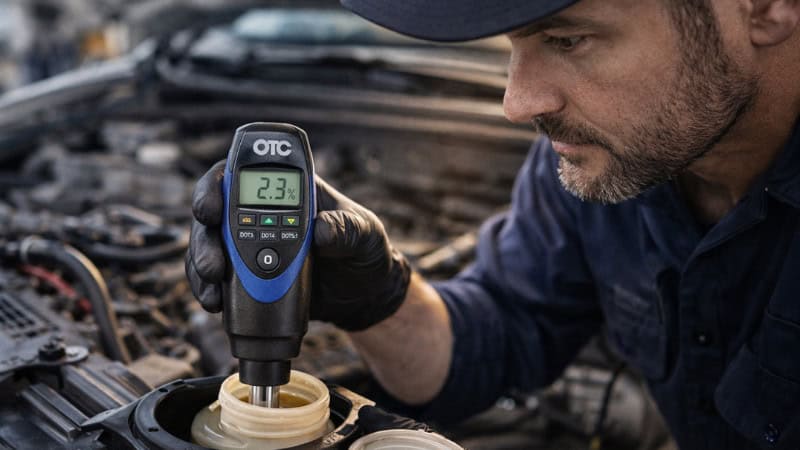
How Brake Fluid Testers Work
Brake fluid testers check for water in your brake fluid. Brake fluid can absorb moisture from the air over time, which lowers its boiling point. As water content rises, you may notice a soft brake pedal or weaker braking, especially under hard use.
Most testers in US shops measure electrical conductivity. Pure brake fluid resists electricity; water makes it conduct better. The tester’s probe reads this, showing you the water percentage. LED testers give a simple pass/fail, while digital ones display an exact percentage. Both work quickly and reliably, doing more than just checking color.

Quick Comparison Table: Best Brake Fluid Testers for 2026
In 2026, brake fluid testers still work much like they always have, but now they’re built tougher, sensors are more consistent, and displays are easier to read. For US mechanics, the real differences are how clearly each tool shows moisture levels and how well it survives daily use in a busy shop. Some testers are made for quick checks during oil changes, while others are best for in-depth brake diagnostics where accuracy counts. The table below gives you a straightforward, practical comparison—no marketing hype—so you can quickly spot which testers are best for pro shops, mobile techs, or occasional DIY jobs without wading through every spec sheet.
| Award / Pick | Product | Type | DOT Compatibility | Accuracy Level | Best For |
|---|---|---|---|---|---|
Best Overall |
Motivx Tools Brake Fluid Tester | LED | DOT 3 / 4 / 5.1 | Good | Daily shop inspections (fast + reliable) |
Best Pro Digital |
OTC 6520 | Digital LCD | DOT 3 / 4 / 5.1 | High | Professional shops needing % moisture readout |
Best Budget |
CTA Tools 7030 | LED | DOT 3 / 4 | Moderate | Budget users + quick safety checks |
Best LED |
Motivx Tools Brake Fluid Tester | LED | DOT 3 / 4 / 5.1 | Good | Fast pass/fail calls in MPI inspections |
Best for DIY |
Klein Tools ET120 | Digital | DOT 3 / 4 / 5.1 | High | Home garage users wanting clear % readings |
Best High-Accuracy |
BOSCH BFT100 | Digital | DOT 3 / 4 / 5.1 | Very High | European cars, ABS diagnostics, precision checks |
Best Compact |
Klein Tools ET120 | Digital | DOT 3 / 4 / 5.1 | High | Mobile mechanics + tool bag carry |
Best Multi-Vehicle |
OTC 6520 | Digital LCD | DOT 3 / 4 / 5.1 | High | Mixed fleets (sedans, SUVs, trucks) |
Best Premium |
OTC 6520 | Digital LCD | DOT 3 / 4 / 5.1 | Very High | High-volume shops (precision + durability) |
9 Best Brake Fluid Testers Reviews 2026
1. Best Overall Brake Fluid Tester: Motivx Tools Brake Fluid Tester
The Motivx Tools Brake Fluid Tester is best overall for balancing accuracy, simplicity, and durability. It delivers consistent readings across DOT 3, 4, and 5.1 fluids with no calibration needed. The clear LED indicator system is suitable for routine inspections and customer explanations.
What makes this tester stand out is its reliability. It doesn’t feel flimsy, and it holds up well to repeated use in a busy bay. While it doesn’t show exact percentages, its moisture ranges are accurate enough for confident service recommendations. For most US mechanics, this tester covers daily needs without slowing down workflow or adding unnecessary complexity.
2. Best Professional Digital Brake Fluid Tester: OTC 6520
The OTC 6520 is built for professional mechanics who want precise data instead of general indicators. This tester provides clear digital moisture percentages, which are especially useful when working on newer vehicles with sensitive ABS and stability control systems. In a professional shop, showing customers an exact number builds trust and reduces pushback on brake fluid service recommendations.
Durability is another strong point. The OTC 6520 feels solid in hand and is designed to withstand frequent use. Readings remain stable even when testing multiple vehicles back-to-back. While it costs more than LED models, the accuracy and consistency justify the investment. For full-time technicians and high-volume shops, this tester is a dependable long-term tool.
3. Best Budget Brake Fluid Tester: CTA Tools 7030
The CTA Tools 7030 is a solid choice for mechanics or DIY owners who need basic brake fluid testing without spending much. It uses a simple LED system to indicate moisture levels, keeping the operation straightforward and minimizing failure points. For occasional use, it performs exactly as expected.
This tester won’t provide detailed data, but it reliably identifies unsafe fluid conditions. That makes it useful for pre-purchase inspections, basic maintenance checks, or small shops with limited diagnostic needs. As long as users understand its limitations, the CTA Tools 7030 offers good value and dependable performance at a budget-friendly price.
4. Best LED Brake Fluid Tester: Motivx Tools Brake Fluid Tester
Among LED-based testers, Motivx Tools stands out for speed and clarity—key benefits for mechanics making quick service decisions. LED testers remain popular in US shops because they enable fast, confident pass-or-fail calls during multi-point inspections. The Motivx unit’s clear indicators allow even busy techs to instantly spot moisture issues and recommend needed service.
For high-volume environments, simplicity matters. There’s no display to crack and no learning curve for new technicians. While it lacks numeric precision, it excels at identifying vehicles that need immediate brake fluid service. For shops focused on efficiency, this LED tester remains a practical and proven choice in 2026.
5. Best Brake Fluid Tester for DIY Car Owners: Klein Tools ET120
The Klein Tools ET120 is ideal for DIY car owners who want reliable results without the complexity of professional tools. Known for electrical testing tools, Klein brings solid build quality and clear digital readings to brake fluid testing. The display is easy to read, and the operation is straightforward even for beginners.
For home use, accuracy and ease of interpretation matter more than speed. The ET120 delivers moisture percentages that help owners make informed maintenance decisions without guesswork. It’s compact, durable, and suitable for occasional testing. From a mechanic’s perspective, it’s a good tool for customers who want to take preventive maintenance seriously.
6. Best High-Accuracy Brake Fluid Tester: BOSCH BFT100
When accuracy is the top priority, the BOSCH BFT100 stands out. Designed to work well with modern braking systems, this tester delivers stable, repeatable moisture readings. It’s especially useful in diagnosing braking issues where fluid condition may be contributing to inconsistent pedal feel or ABS behavior.
BOSCH’s sensor quality shows in consistent results across multiple tests. For mechanics tracking brake fluid degradation over time, this reliability is valuable. While it’s priced higher than basic testers, the precision makes it worthwhile for performance vehicles, European cars, and advanced brake systems commonly seen in US shops.
7. Best Compact Brake Fluid Tester: Klein Tools ET120
The compact Klein Tools ET120 fits easily into tool bags or mobile setups, providing accurate digital readings across DOT fluids. For mobile mechanics or roadside service, its portability and reliability are key advantages.
The ET120’s rugged design withstands transport and a wide range of environments. It may not have the premium feel of larger shop tools, but its practicality makes it a strong option for technicians who need dependable testing on the go.
8. Best Multi-Vehicle Brake Fluid Tester: OTC 6520
For shops servicing a wide range of vehicles, the OTC 6520 excels in versatility. It handles DOT 3, DOT 4, and DOT 5.1 fluids consistently, making it suitable for everything from compact sedans to heavy pickups. This flexibility reduces tool switching and speeds up inspections.
In fleet or mixed-vehicle environments, consistency matters more than convenience. The OTC 6520 delivers dependable readings regardless of vehicle type, helping mechanics make confident service decisions across diverse platforms.
9. Best Premium Brake Fluid Tester: OTC 6520
At the premium end, the OTC 6520 stands alone. Its build quality, accuracy, and long-term reliability justify the higher price. This is the type of tool professional mechanics buy once and use for years without second-guessing results.
For shops focused on precision, customer trust, and long-term durability, the OTC 6520 remains one of the best brake fluid testers available in 2026.
Frequently Asked Questions
1. Are brake fluid testers actually accurate?
Brake fluid testers are accurate enough for real-world service decisions when used correctly. They measure moisture content, which is the primary indicator of brake fluid degradation. While they are not laboratory instruments, quality testers provide consistent, repeatable readings that help mechanics determine whether the fluid is safe or due for replacement. In US shops, they are widely trusted for inspections, preventive maintenance, and customer recommendations, especially when results are consistent across multiple tests.
2. How often should brake fluid be tested?
In general, brake fluid should be tested at least once a year or during every major service interval. Many US mechanics also test brake fluid during oil changes or brake inspections, especially on vehicles older than two years. Climate, driving habits, and vehicle type all affect moisture buildup. Regular testing helps catch problems early and prevents heat-related brake fade or internal corrosion before expensive components are damaged.
3. What moisture percentage means brake fluid needs to be replaced?
Most mechanics consider brake fluid replacement necessary when the moisture content reaches about 3%. At this level, the boiling point drops significantly, increasing the risk of brake fade under hard braking. Some shops recommend replacing at 2% as a preventive measure, especially for performance vehicles or heavy-duty use. The exact threshold may vary, but consistent readings above safe limits indicate it’s time for a flush.
4. Can brake fluid testers be used on DOT 5 brake fluid?
Standard brake fluid testers should not be used on DOT 5 silicone brake fluid. DOT 5 does not absorb moisture as glycol-based fluids do, so conductivity-based testers cannot accurately measure it. Using a tester on DOT 5 will give misleading results and may lead to unnecessary service recommendations. Always confirm the brake fluid type before testing to ensure accurate and reliable results.
5. Do digital brake fluid testers need calibration?
Most modern digital brake fluid testers are factory-calibrated and do not require routine calibration. However, they should be kept clean and used according to the manufacturer’s instructions to maintain accuracy. Contaminated probes or damaged sensors can affect readings over time. In professional US shops, replacing worn testers is often more practical than recalibration, especially when accuracy starts to decline.
6. Is an LED brake fluid tester good enough for safety inspections?
For basic safety inspections, an LED brake fluid tester is usually sufficient. These testers clearly indicate whether fluid is within a safe range or overdue for service. While they don’t provide exact moisture percentages, they are fast, consistent, and easy to interpret. Many US shops rely on LED testers for routine inspections and use digital testers only when more detailed diagnostics are required.
Conclusion
Brake fluid is one of those maintenance items that rarely gets attention until something goes wrong, yet it plays a critical role in vehicle safety. In 2026, with modern cars relying heavily on ABS and electronic braking systems, ignoring brake fluid condition is no longer an option. A quality brake fluid tester gives mechanics and car owners a clear, objective way to assess fluid health, rather than relying on guesswork or outdated mileage-based rules.
For US mechanics, these tools help support honest service recommendations, reduce comebacks, and improve overall brake performance. For DIY owners, they offer an easy way to stay ahead of problems before they turn into costly repairs. Whether you choose a simple LED tester or a professional-grade digital unit, regular brake fluid testing is a small step that delivers big safety benefits.
