
Can you use 10W-30 instead of 5W-30? Sometimes, yes—but it’s not always simple. The main difference is the first number: 5W-30 flows better during cold starts. That matters because most engine wear happens right after startup, especially in cold weather. Once the engine is warm, both oils act as “30 weight” and protect similarly. The key factors are your climate, engine, and your manual’s recommendation. If you live somewhere warm and your manual allows 10W-30, it’s usually fine. In cold climates, stick with 5W-30 for better protection.
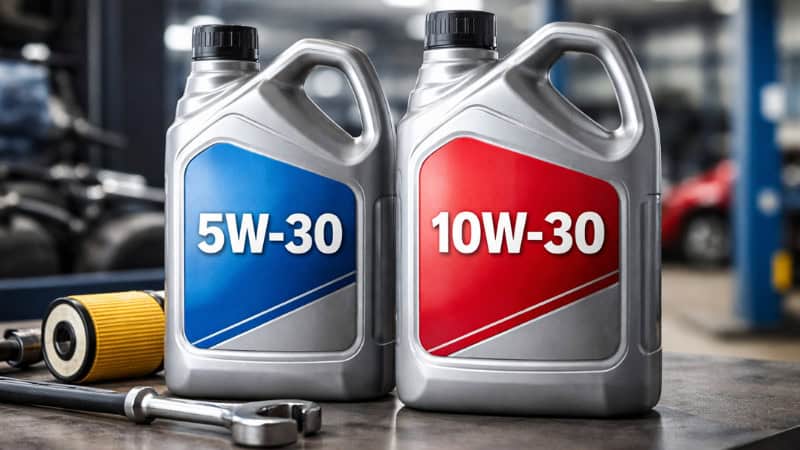
What 10W-30 and 5W-30 actually mean
The numbers on your oil bottle are viscosity grades—how thick the oil is at different temperatures. The ‘W’ means winter, and the number before it shows how well the oil flows in cold conditions. 5W oil stays thinner in the cold, so it moves faster during chilly starts. The second number, 30, is the thickness when fully warmed up. Both protect similarly at high temperatures but act differently at startup. Think of honey: it’s easy to pour warm and thick when cold. 10W-30 is thicker at cold starts, which can cause problems for some engines.
The real-world difference in your engine
Most engine wear happens right after you start your car, not while cruising. Cold oil sits thick in the pan. The pump must push this oil to crank bearings, camshaft, lifters, and timing components. 5W-30 gets there faster in the cold because it’s thinner. 10W-30 can be slower on cold mornings, leaving parts “drier” for a few more seconds. Modern engines with variable valve timing or turbos may briefly rattle or wear more over time. In warm weather, this difference shrinks, so 10W-30 is fine if your manual allows it.
Can you use 10W-30 instead of 5W-30?
If your manual allows 10W-30, you can use it safely. That’s the main check. Manufacturers design engines for specific oil thickness and test for flow, variable valve timing, and cold starts. If the manual only lists 5W-30, your engine needs that fast cold flow for protection and emissions. Some manuals have viscosity charts—if 10W-30 is listed for certain temps, it’s approved. Next, consider climate: if it’s not very cold, 10W-30 is usually safe. Engine design matters: older, simpler engines handle thicker oil better than modern turbo- or VVT-equipped engines. Emergency top-offs are a different topic.
When 10W-30 is a good idea vs when it’s a bad idea
10W-30 works in warm weather, older engines, or if your car uses oil. Thicker oil can help reduce leaks and slow consumption, especially during hot summers or long trips. But for cold starts, it’s not ideal. In near-freezing mornings, thicker oil means slower lubrication and increased engine wear. For modern engines that require fast-flowing oil for VVT and tight internal spaces, using thicker oil can lead to insufficient lubrication and potential component damage. If your car has a turbo or is sensitive to oil specs, always use what the manual lists, and check the bottle matches.
Temperature guidance
The colder the weather, the more you need 5W-30. The main difference between 5W and 10W is seen in cold conditions. In warm places, both work the same once heated, so 10W-30 is fine if your manual recommends it. For cold mornings, short trips, or quick starts, 5W-30 flows faster and is safer. If you see freezing temps often, use 5W-30. If winters are mild and your manual allows 10W-30, it’s also safe. Cars in garages start more easily than those kept outside.
What can go wrong if you run 10W-30 when it calls for 5W-30
You won’t usually ruin an engine right away, but specific risks remain—especially with months of cold starts. The main risk is slower oil flow at startup, which increases wear on crank bearings, cam lobes, timing chains, and lifters. In some modern engines, you may notice a brief timing chain rattle or VVT hesitation because these systems depend on rapid oil flow. In cold weather, 10W-30 can make the engine feel sluggish for the first few minutes. Another risk is reduced fuel economy, since thicker oil at startup takes more energy to pump. If your vehicle is under warranty and the manual doesn’t approve 10W-30, using it can complicate an engine-related claim. The risk is lowest in warm temperatures and older engines.
The oil “spec” is just as important as the weight
Many DIY oil changes go wrong because people match the viscosity (5W-30) but ignore the spec. Your engine needs more than “30 weight”; it wants specific standards for detergents, wear protection, turbo heat, and deposit prevention. In the US, common gas-engine labels include API SP and ILSAC GF-6. Some brands (like GM) call for Dexos1 approval. If your oil doesn’t meet the required spec, you may see more deposits, faster timing chain wear, or issues with turbo- or GDI-powered engines—even if the viscosity is correct. When comparing 10W-30 vs 5W-30, both must meet your required spec. If the 10W-30 doesn’t match the required spec, it’s a no, even if viscosity seems close.
you may like: Engine Cooling System Parts and Their Functions
Should you switch to 10W-30 to stop oil burning?
If your engine is older and uses oil, switching from 5W-30 to 10W-30 might reduce consumption a bit in warm weather—but it’s not the first step I’d take. Oil burning usually comes from leaks, a weak PCV system, stuck piston rings, or worn valve seals. A thicker cold grade doesn’t fix those; it just sometimes hides symptoms. In most cases, try a high-mileage 5W-30 that meets the right spec. These oils have seal conditioners and additives for older engines, while still maintaining the cold-start flow your engine was designed for. If you’re in a hot climate, the manual allows 10W-30, and the engine is out of warranty, then switching can be reasonable—especially if you’re topping off often. But if you deal with cold starts, stay with 5W-30 and fix the cause.
turbos, GDI, VVT, and why they’re picky
Modern engines aren’t like old 5.0s and 4.3s that ran on anything. Turbos spin fast and need a thin, steady oil film in tight bearings. GDI engines run hotter in spots and are more sensitive to deposits and knock, so oil formulation matters. VVT systems and cam phasers use oil through small passages to control timing; if oil is too thick when cold, response delays, startup rattle, or even error codes can happen. Many newer vehicles specify 5W-30 (or thinner grades) and require a strict spec, such as API SP/GF-6 or manufacturer approval. If your car has a turbo, start-stop, or is known for timing chain issues, play it safe: use the exact viscosity and spec the manual calls for. “Close enough” can be costly later.
Topping off with 10W-30 vs doing a full change
If you’re low on oil and only find 10W-30, topping off is better than running low. Low oil can starve the pump during turns or hard braking, risking bearing failure. In a pinch, add enough to reach a safe level and watch it. For a full change, follow the manual, since that’s what your engine was designed for. If it’s winter-cold, top off with 10W-30 and switch back to 5W-30 soon. In warm temps, if the manual allows both, you can run either oil—if it meets the right spec. Bottom line: top-off is flexible, full fill always follows the manual.
Mixing oils comes up a lot—so can you blend 5W-30 and 10W-30?
Yes, you can mix them if you have to—brands and grades are usually compatible if meant for the same engine (gas or diesel) and meet the right spec. Mixing doesn’t cause a dangerous reaction. It just results in a slightly thicker cold flow. Adding 10W-30 to a 5W-30 engine thickens the blend a little during cold starts. For a small top-off, it’s fine, especially in warm weather. For repeated mixing, stick with one viscosity your manual approves for predictability and accurate tracking. Mixing two oils that don’t meet your required spec is still a problem—spec matters more than brand. If you’re under warranty, keep records and follow the manual.
Quick checklist before you decide
Before pouring, do a pre-check. First, open your manual or oil cap for the recommended viscosity and allowed alternatives. Some manuals show a temp chart—if 10W-30 is listed, you’re good in that range. Next, check the oil bottle for your engine’s spec—API SP/ILSAC GF-6 and any manufacturer approvals (like dexos). Consider your real conditions: coldest starts, short trips, towing, and if the vehicle sits outside. Engine design matters: turbo, VVT, and GDI engines are more sensitive to cold-flow and specs. To top it off, you have some flexibility. For a full oil change, always follow the manual.
FAQ
FAQ 1: Can I use 10W-30 instead of 5W-30?
Yes, if your owner’s manual allows 10W-30 for your engine and your climate. The big difference is cold flow: 10W-30 is thicker on cold starts than 5W-30. In warm temps, both protect similarly once the engine is hot because both are “30 weight.” In cold weather, stick with 5W-30 to avoid slow startup lubrication and potential VVT/timing noise.
FAQ 2: Is 10W-30 thicker than 5W-30?
When cold, yes. The “10W” means it’s thicker in winter conditions than “5W,” so it pumps slower on cold starts. When fully warmed up, both are the same “30” hot viscosity grade, so at operating temp they’re similar. People get tricked by the matching “30.” The real difference is in those first minutes after startup, especially in freezing temperatures or on short trips.
FAQ 3: Will 10W-30 increase oil pressure?
It can, especially at a cold start, because thicker oil often shows higher pressure on the gauge. But higher pressure doesn’t automatically mean better protection—flow is what lubricates bearings and valvetrain parts. Some engines need quick flow through small passages for VVT and timing components. So chasing pressure with thicker oil can backfire in cold weather. Follow the manual’s viscosity range and required oil spec.
FAQ 4: Can 10W-30 damage an engine that requires 5W-30?
Usually not instantly, but it can increase wear over time if you’re starting the engine in cold conditions. The risk is highest with modern engines that have tight clearances, turbos, and VVT systems that rely on fast oil flow. If the manual doesn’t approve 10W-30, don’t run it as your normal fill. A small emergency top-off is typically safer than driving low.
FAQ 5: Is 10W-30 better for high-mileage engines?
Sometimes, in warm climates and older engines, it may reduce minor oil consumption or quiet a little startup noise. But it’s not a real fix. If your engine calls for 5W-30, a high-mileage 5W-30 is often the smarter move because it maintains cold-start flow while providing seal conditioners and additives designed for older engines. Always match the required API/ILSAC/manufacturer spec.
FAQ 6: Can I mix 5W-30 and 10W-30?
Yes, mixing is generally safe for a top-off, and it won’t create a harmful chemical reaction. You’ll end up with a blend that’s slightly thicker when cold than straight 5W-30. For a small amount, that’s usually fine—especially in warm weather. Long term, don’t make mixing a habit. Pick the correct viscosity and oil spec your manual recommends to maintain consistent VVT behavior and wear protection.
FAQ 7: Which is better in winter: 5W-30 or 10W-30?
For winter, 5W-30 is the better choice almost every time. It flows faster during cold starts, when engines experience the most wear. If you’re dealing with freezing mornings, short trips, or the vehicle sits outside overnight, 5W-30 helps deliver oil to critical parts more quickly. Only use 10W-30 in winter if the manufacturer explicitly allows it for your temperature range.
FAQ 8: Which is better in summer: 5W-30 or 10W-30?
In summer, the gap between them gets smaller because both oils are “30 weight” at operating temperature. In hot climates, 10W-30 can be acceptable if your manual approves it, and some older engines may like it. But don’t assume “summer = thicker is better.” Modern turbo/VVT engines still care about specs and flow. If 5W-30 is the factory fill, it’s still a safe year-round pick.
Conclusion
If your engine calls for 5W-30, that’s the safe, do-it-right choice—especially for modern cars, cold starts, turbos, and VVT systems. 10W-30 isn’t automatically “wrong,” but it’s only a smart swap when your owner’s manual allows it and your driving conditions are mostly warm. Remember: both are “30 weight” hot, but 5W-30 wins on cold-start flow, which is where most wear happens.
For an emergency top-off, a little 10W-30 is usually better than running low on oil. For a full oil change, match the viscosity range + required oil spec (API SP / ILSAC GF-6 / manufacturer approval). That’s how you keep engines alive long-term.
