
Whether you’re doing a quick oil change or complex repairs, a floor jack is essential—but dangerous if misused. Thousands are injured yearly in the US by rushing, skipping jack stands, or using worn equipment. Floor jacks lift vehicles but don’t support them, a lesson some DIYers learn after accidents.
This guide will show you how to use a floor jack safely, just like professional mechanics do in real shops. No gimmicks or internet myths here—just straightforward, proven safety habits that can keep you safe while working under a car.

What Is a Floor Jack and How It Works
A floor jack is a hydraulic tool that lifts vehicles for access underneath or to remove wheels. Most US garages use them for stability, easy control, and the ability to move with the vehicle during lifts. Unlike the small scissor jack—a compact, screw-operated jack found in your car for emergencies—floor jacks are built for regular use and heavier loads.
A hydraulic pump moves oil through a sealed system. Pumping the handle increases pressure and raises the saddle—the metal pad on top of the jack that contacts the vehicle. Opening the release valve (a knob or lever) releases pressure, lowering the vehicle. Hydraulic systems transmit force through liquid pressure but can fail suddenly due to worn seals, slipping valves, or pressure loss. That’s why professional mechanics never rely solely on a floor jack.
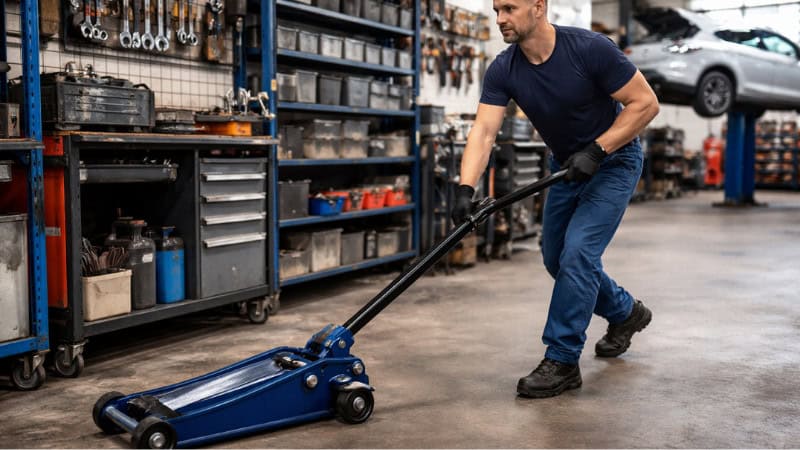
Types of Floor Jacks (Choosing the Right One)
#1 Standard Hydraulic Floor Jack
- Best for sedans, coupes, crossovers, and light SUVs.
- Rolls as the vehicle lifts, reducing side-load stress.
- Wide stance for better stability on concrete floors .
#2 Low-Profile Floor Jack
- Fits under lowered cars and sports cars.
- Prevents forcing the suspension upward at an angle.
- Reduces the risk of damaging pinch welds or bumpers.
#3 Long-Reach / Heavy-Duty Floor Jack
- Designed for trucks, vans, lifted SUVs, and work vehicles.
- Higher lift range with better control at full extension.
- Reduces strain on the hydraulic system.
#4 Aluminum vs Steel Floor Jacks
Material choice affects both safety and convenience, especially in home garages and professional US shops.
Steel Floor Jacks
- Extremely durable and stable under heavy loads.
- Heavier and harder to move around the shop.
- Common in fixed shop bays and professional garages.
Aluminum Floor Jacks.
- Much lighter and easier to maneuver.
- Popular with mobile mechanics and DIYers.
- Must be high quality to avoid flexing under load.
Both steel and aluminum floor jacks are safe when properly built. However, cheap aluminum jacks are typically avoided by professionals due to stability and long-term durability concerns.
#5 Racing / Performance Floor Jacks
- Fast lift action and lightweight design.
- Ideal for tire changes and track use.
- Not ideal for heavy trucks or uneven floors.
Floor Jack Weight Ratings Explained
Floor jack weight ratings, like 2-ton or 3-ton, are often misunderstood. A 2-ton jack does not guarantee safe lifting of a 4,000-pound vehicle. The rating reflects the maximum load under ideal conditions, not a safety margin. Mechanics choose jacks with additional capacity for safety.
While most cars can be lifted with a 2-ton jack, SUVs, trucks, and electric vehicles often exceed this limit. Many American shops use 3-ton floor jacks for added stability. Operating near maximum capacity increases wear and failure risk, so a higher-capacity jack is generally safer.
Before You Jack Up a Vehicle
Before using a floor jack, proper setup is essential for safety. Mechanics consider this step essential. Park on level, solid ground—preferably concrete. Avoid jacking on hot asphalt or uneven surfaces. Set the parking brake and put the transmission in Park or gear (if manual).
Wheel chocks are critical and often skipped. Chock wheels that stay on the ground to prevent rolling. Inspect your jack for leaks, bent handles, or jerky movement. If something feels off, don’t use it. A quick check now prevents injuries.
Where to Place a Floor Jack
Proper floor jack placement is a critical safety factor. Every vehicle has manufacturer-approved jack points—reinforced spots underneath the car, such as notched seams or solid metal areas, designed to support its weight. These are typically listed in the owner’s manual. Common safe locations include reinforced pinch welds (the thick, folded seam along the car’s underbody), frame rails (the metal beams running the length of the car), front crossmembers (the horizontal support between frame rails), and solid axle housings (heavy metal tubes that house the axle) on trucks.
Never place a jack under weak parts like the oil pan, transmission pan, exhaust, or plastic panels, which can fail. Many mechanics use a rubber jack pad to protect pinch welds and prevent slipping. If the saddle isn’t centered and stable, stop and reposition the jack.

How to Use a Floor Jack Safely
Safe floor jack operation relies on control, proper positioning, and discipline. Professional mechanics follow a consistent process, as skipping any step can result in serious accidents. The following outlines the correct procedure for lifting a vehicle with a floor jack.
Step 1: Position the Floor Jack Correctly
Roll the floor jack under the vehicle so the saddle aligns with the manufacturer-approved jack point. The jack must be centered—not slightly off, not “close enough.” If the saddle isn’t square to the lifting point, the vehicle can slip as the weight transfers. Make sure the jack handle has a full range of motion and won’t hit the bumper, rocker panel, or bodywork while pumping.
Experienced mechanics always pause to double-check alignment. If the setup appears incorrect, reposition the jack before lifting.
Step 2: Pump the Handle Slowly and Evenly
Pump the handle with controlled, smooth movements. Avoid rushing or forcing the lift. Some jack movement as the vehicle rises prevents side-loading. Prioritize stability over height.
If you observe the saddle shifting, metal flexing, or the vehicle leaning, stop immediately. Lower the jack and correct the setup. Lifting slowly allows time to identify and address issues before they become hazardous.
Step 3: Lift Only as High as Necessary
Lifting higher than needed is a common mistake. Extra height increases instability, especially on uneven surfaces. Lift only as much as needed to work or remove wheels.
Professional mechanics keep lifts as low as possible. Lower lifts reduce leverage, minimize sway, and provide greater control.
Step 4: Place Jack Stands Immediately
A floor jack lifts, but should not support a vehicle. After lifting, place jack stands under frame rails, reinforced pinch welds, or truck axles. Ensure both stands are at equal height and locked.
Verify that the jack stands are rated for the vehicle’s weight. In professional settings, stands are set before anyone works under the vehicle.
Step 5: Lower the Vehicle Onto the Jack Stands
Slowly open the jack’s release valve and let the vehicle settle onto the stands. This should be done gently—no sudden drops. Once the weight is fully on the stands, slightly lower the jack further so it’s no longer carrying the load, but keep it positioned underneath as a secondary precaution.
Perform a stability check by pushing the vehicle firmly from the side. If there is any movement, reset the setup. If the vehicle remains stable, it is safe to proceed.
Step 6: Keep Redundant Safety in Mind
Many pros add a backup safety step, especially when working alone. This can include sliding a wheel under the frame or keeping the jack lightly under a second lift point. These don’t replace stands—but can prevent injury if stands fail.
Key Safety Reminders Mechanics Live By
- Never rush a lift, even for “quick jobs.”
- Never crawl under a car supported only by a floor jack.
- Always trust jack stands, not hydraulics.
- If something feels unstable, stop and reset.
Using a floor jack safely means respecting weight and physics. Do it the right way, and it’ll serve you for years without incident.
Never Work Under a Car Supported Only by a Floor Jack
This rule is absolute in every professional US repair shop: never get under a vehicle supported only by a floor jack. A hydraulic jack can fail without warning. Seals wear out, valves slip, and internal pressure can drop instantly—even if the jack seemed fine moments earlier. When that happens, the vehicle comes down fast.
Many serious garage injuries and fatalities occur during “quick jobs” such as checking the exhaust, tightening a bolt, or performing a quick inspection. People think they’ll be under the car for just a second, but accidents don’t give warnings. Jack stands are designed to mechanically lock the vehicle in place, whereas hydraulics cannot. In real-world shop culture, if jack stands aren’t in place, the job doesn’t start—no exceptions.
Common Floor Jack Safety Mistakes
Most floor jack accidents are caused by avoidable mistakes, not tool defects. Using an under-rated jack, such as a 2-ton jack for a heavy SUV or EV, increases the risk of failure. Jacking on uneven or soft surfaces can cause the jack to shift under load.
DIYers also skip wheel chocks more than they should, especially when lifting only one end of the car. Forgetting jack stands is another classic problem, usually justified by “I’ll be under there for just a second.” Worn-out jacks with leaking hydraulics are also dangerous. In US shops, if a jack doesn’t feel smooth and solid, it gets taken out of service immediately.
Floor Jack Maintenance for Safety
A floor jack is only as safe as its condition, and professional US mechanics take regular maintenance seriously. Over time, hydraulic fluid can break down or leak, leading to reduced lifting power or sudden drop-offs. Periodically check the jack for visible oil leaks around the pump and cylinder. If the jack won’t hold pressure or feels spongy while pumping, it likely needs fluid service or bleeding.
Air trapped in the hydraulic system is another common issue and can usually be fixed by bleeding the jack according to the manufacturer’s instructions. Store the jack in a lowered position to protect the piston from corrosion. Also, inspect the wheels, saddle, and handle for damage. If a jack shows structural cracks or won’t hold a load, replacement is safer than repair.
FAQ
FAQ 1: Can I Use a Floor Jack on Gravel or Dirt?
Short answer: No, and experienced mechanics won’t do it. Gravel and dirt don’t provide a stable surface, so the jack can sink, shift, or tilt as weight is transferred. That’s how vehicles slip off jacks. A floor jack is designed to roll slightly during lifting, and loose ground prevents that movement. If you have no choice, use thick steel plates or heavy plywood as a base, but concrete is always the safest option.
FAQ 2: How Many Jack Stands Do I Really Need?
At a minimum, you need two jack stands for one end. At a minimum, use two jack stands for one end of a vehicle. One stand is never sufficient. If lifting the entire vehicle, use four jack stands, one at each corner. Professional shops always use pairs of equal-height stands to maintain vehicle stability. Mixing heights or using mismatched stands can twist the chassis and cause slipping. When uncertain, opt for more support rather than less.
FAQ 3: Is a 2-Ton Floor Jack Enough for an SUV?
In most cases, no. While some compact SUVs may fall within range, a 2-ton jack is often working at its limit. Mechanics usually recommend a 3-ton floor jack for SUVs, crossovers, trucks, and EVs. Running a jack near max capacity increases hydraulic stress and failure risk. A higher-capacity jack lifts easier, stays more stable, and lasts longer. In the garage world, extra capacity equals extra safety.
FAQ 4: Can I Lift Just One Side of a Car Safely?
Yes, lifting one side of a car can be safe if performed correctly. This method is common for brake jobs or tire rotations, but wheel chocks are essential. Chock the wheels remaining on the ground at both the front and back to prevent rolling. Always use jack stands on the lifted side before working. Do not rely solely on the steering lock or parking brake. One-sided lifts are safe when performed carefully and controlled.
FAQ 5: Are Aluminum Floor Jacks Safe to Use?
Yes, aluminum floor jacks are safe when they are high-quality and properly rated. Many professional mechanics use aluminum jacks for their lighter weight and ease of movement. It is important to choose a reputable brand with a solid saddle and strong welds, as inexpensive aluminum jacks may flex under load. Steel jacks are heavier but highly durable. Both types are safe when used correctly with jack stands and appropriate capacity ratings.
FAQ 6: Why Does My Floor Jack Slowly Lower on Its Own?
A jack that slowly lowers itself is a warning sign. This typically indicates internal seal wear, contaminated hydraulic fluid, or air in the system. Do not use the jack until the issue is resolved. In professional shops, any jack that cannot hold pressure is removed from service immediately. Bleeding the system or replacing fluid may resolve the issue, but if the problem continues, replacement is the safest option.
Conclusion
A floor jack is one of the most useful tools in any garage, but it demands respect. Used correctly, it makes maintenance and repairs safer and easier. Used carelessly, it can cause serious injury or worse. The difference comes down to preparation, proper placement, correct equipment, and never skipping jack stands.
US mechanics follow these steps consistently because they are effective. Whether changing oil at home or performing suspension work, the same safety rules apply. Take your time, use appropriate tools, and double-check your setup. Investing an extra minute in safety is always worthwhile when working under a vehicle.
