
Universal joints (U-joints) are vital to your vehicle’s drivetrain. They let the driveshaft transfer power smoothly as it moves with the suspension. Without U-joints, you can’t have seamless power delivery. Most drivers ignore U-joint maintenance until failure causes expensive damage. Dry or seized U-joints create vibrations, clunking, or even a broken driveshaft. Greasing them regularly is easy and greatly extends the life of the drivetrain. Whether driving daily or hauling heavy loads, keep U-joints lubricated to ensure smooth operation, less wear, and fewer surprise repairs.

What Is a U-Joint and How It Works
A U-joint is a flexible part joining two rotating shafts at different angles. In most vehicles, it sits between the driveshaft and the transmission or differential. Needle bearings inside the U-joint allow rotation and absorb angular movement from suspension travel. These bearings need grease to reduce friction and heat. As the driveshaft spins, the U-joint constantly changes angle, so lubrication is essential. Without grease, metal contacts metal, causing rapid wear. A good U-joint keeps power delivery consistent, reduces vibration, and helps your drivetrain handle torque.
Signs Your U-Joints Need Greasing or Service
U-joints usually give warning signs before complete failure. One of the most common symptoms is a clunking sound when shifting from park to drive or reverse. You may also notice vibrations at highway speeds, especially under acceleration. Squeaking noises at low speeds can indicate dry needle bearings. In more advanced cases, rust-colored dust around the joint signals internal bearing wear. Excessive play in the driveshaft when twisted by hand is another red flag. Ignoring these signs can lead to joint seizure, which may cause drive shaft damage or loss of vehicle control. Regular inspection and greasing can catch these problems early and prevent expensive repairs.
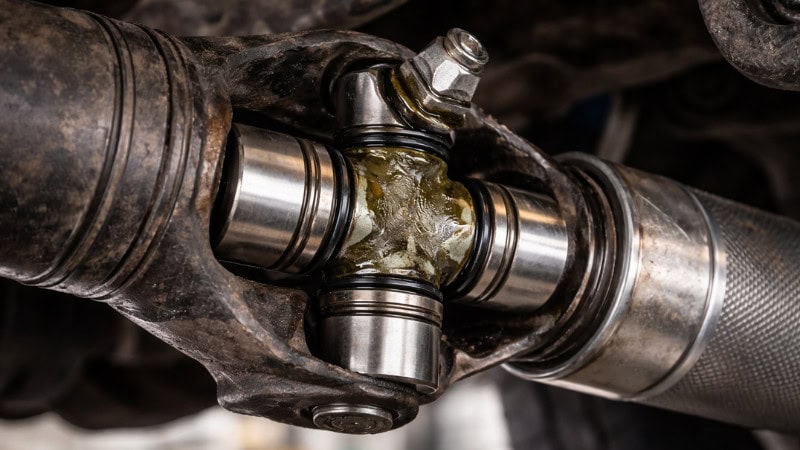
Tools and Materials Needed to Grease U-Joints
Greasing U-joints doesn’t require specialized shop equipment, but using the right tools makes the job effective and safe. A quality grease gun is essential, preferably with a flexible hose to reach tight fittings. The grease itself should be NLGI #2 lithium-based or synthetic grease formulated for high-pressure drivetrain use. Check that your choice is specifically rated for use on U-joints or chassis components. Safety gear such as gloves and eye protection is strongly recommended, especially when working under the vehicle. You’ll also need a clean rag to wipe off old grease and dirt before and after lubrication. If the vehicle has skid plates or shields, basic hand tools may be required to access the driveshaft. Proper preparation ensures clean, effective lubrication.
Step-by-Step: How to Grease U-Joints Properly
Follow this standard procedure used in most U.S. repair shops:
- Park the vehicle on a level surface and set the parking brake.
- If additional clearance is needed, raise the vehicle using a lift or approved jack stands.
- Locate the driveshaft and identify all grease fittings (zerk fittings) on the U-joints.
- Rotate the driveshaft by hand if necessary to access hidden fittings.
- Wipe each grease fitting clean with a shop rag to prevent contamination.
- Attach the grease gun securely to the fitting.
- Pump grease slowly and steadily into the joint.
- Continue greasing until fresh grease appears at the bearing seals.
- Stop pumping once all bearing caps show clean grease.
- Remove the grease gun carefully to avoid damaging the fitting.
- Wipe away excess grease from the joint and surrounding components.
- Rotate the driveshaft by hand to confirm smooth, free movement.
- Repeat the process for all serviceable U-joints.
Important Shop Notes:
- Do not over-grease; excessive pressure can damage bearing seals.
- Use NLGI #2 grease rated for drivetrain applications.
- If the joint binds, clicks, or remains noisy after greasing, replacement is recommended.
- Sealed U-joints cannot be greased and must be replaced when worn.
Common Mistakes When Greasing U-Joints
A common mistake people make is over-greasing, which can rupture the bearing seals and allow contaminants to get trapped inside the joint. Using the wrong type of grease—such as general-purpose grease instead of one designed for drivetrains—can also cause problems. Some vehicle owners try to grease sealed U-joints, unaware that they are not serviceable. Skipping the cleaning step before greasing pushes dirt into the bearings, accelerating wear. Delaying service too long can let joints run dry and shorten their lifespan. Finally, if you notice vibrations or noise after greasing, it could mean there’s internal damage that grease alone can’t fix. Using the proper technique and inspecting your U-joints regularly is just as important as choosing the right grease.
Grease Types and Service Intervals
Benefits of Properly Greased U-Joints
Keeping your U-joints properly lubricated offers multiple long-term benefits for both performance and reliability.
- Smooth and consistent power transfer.
- Reduced drivetrain vibration and noise.
- Extended driveshaft and differential life.
- Lower risk of sudden U-joint failure.
- Improved fuel efficiency due to reduced friction.
- Better performance under towing and heavy loads.
- Reduced maintenance costs over time.
Proper lubrication is one of the simplest yet most effective ways to protect your drivetrain investment. Make regular greasing a routine part of your maintenance for reliable performance and peace of mind on the road.
How Often Should You Grease U-Joints?
Service needs depend on how you drive. Most daily vehicles should have their U-joints greased at every oil change or every 5,000 miles. Vehicles that tow, go off-road, or work hard need greasing every 2,000–3,000 miles. Water, mud, or salt requires more frequent service. Always check the manufacturer’s schedule, but real-world use usually means more frequent greasing. Regular lubrication keeps bearings from drying out, prevents heat buildup, and improves reliability.
When Greasing Isn’t Enough
While greasing extends U-joint life, it cannot fix internal damage. If a joint shows excessive looseness, binding, or grinding even after lubrication, replacement is necessary. Rust inside the bearing caps or missing needle bearings are clear indicators of failure. Persistent vibrations, clunks, or squeaks after greasing suggest worn components. Continuing to drive with a failing U-joint can damage the driveshaft, transmission, or differential. Replacement costs are relatively low compared to the potential cost of drivetrain damage. A mechanic will typically recommend replacement once wear reaches a critical point, ensuring safety and preventing unexpected breakdowns.
FAQ
FAQ 1: What Does a U-Joint Do in a Vehicle?
A U-joint, or universal joint, allows the driveshaft to transmit power from the transmission to the differential while operating at changing angles. As the suspension moves up and down, the driveshaft angle changes, and the U-joint compensates for that movement. Without U-joints, the drivetrain would bind or fail under load. They are critical for smooth power delivery, especially in rear-wheel-drive and four-wheel-drive vehicles.
FAQ 2: Why Do U-Joints Need to Be Greased?
U-joints contain needle bearings that rely on grease to reduce friction and heat. Grease creates a protective film that prevents metal-to-metal contact during rotation. Without proper lubrication, the bearings wear rapidly, leading to noise, vibration, and eventual failure. Greasing also helps flush out moisture and contaminants. Regular lubrication significantly extends U-joint life and helps prevent sudden drivetrain breakdowns.
FAQ 3: How Can I Tell If My U-Joints Are Dry or Worn?
Common symptoms of dry or worn U-joints include clunking noises when shifting gears, vibrations at highway speeds, squeaking sounds at low speeds, and visible rust around the joint caps. You may also feel looseness when rotating the driveshaft by hand. If ignored, these symptoms can worsen and lead to joint seizure or drive shaft damage. Early detection through inspection and greasing is key.
FAQ 4: How Often Should U-Joints Be Greased?
For most vehicles with greaseable U-joints, lubrication every 5,000 miles or at each oil change is recommended. Vehicles used for towing, off-roading, or driving in wet or dusty environments may require more frequent service, sometimes every 2,000–3,000 miles. Always follow manufacturer guidelines, but real-world conditions often demand shorter intervals to ensure proper protection and long-term reliability.
FAQ 5: Can You Over-Grease a U-Joint?
Yes, over-greasing a U-joint is possible and can cause damage. Excessive pressure can rupture bearing seals, allowing dirt and moisture to enter later. Over-greasing can also cause grease to flow unevenly, trapping contaminants inside the joint. The correct approach is to pump grease slowly until fresh grease appears at the seals, then stop. Proper technique is just as important as lubrication itself.
FAQ 6: What Type of Grease Is Best for U-Joints?
Most mechanics recommend NLGI #2 lithium-based or synthetic grease specifically made for drivetrain and U-joint applications. Synthetic grease offers greater high-temperature resistance and longer service life, which is beneficial for trucks and other heavy-duty vehicles. General-purpose grease is not suitable, as it may break down under heat and load. Always pick grease that is labeled for chassis or driveline use to ensure proper protection.
FAQ 7: Are all U-joints greaseable?
No, not all U-joints are greaseable. Many modern vehicles come equipped with sealed U-joints that lack grease fittings. These joints are designed to last a set service life and must be replaced when worn. Attempting to grease a sealed U-joint is not possible. Regular inspection is especially important for sealed joints since lubrication cannot extend their lifespan.
FAQ 8: What Happens If a U-Joint Fails While Driving?
A failed U-joint can cause severe drivetrain damage and may result in loss of vehicle control. In extreme cases, the driveshaft can detach, damaging the transmission, exhaust, or underbody components. You may experience sudden vibrations, loud banging noises, or an inability to move the vehicle. This is why regular inspection and lubrication are critical—U-joint failure is often preventable with proper maintenance.
Final Thoughts
U-joint maintenance might seem easy to forget, but it’s one of the best ways to protect your vehicle. Just a few minutes with a grease gun can save you hundreds—or even thousands—of dollars in repairs. Regular greasing keeps your drivetrain quiet, smooth, and reliable. No matter what you drive, don’t skip U-joint lubrication. Watch for warning signs, choose the correct grease, and stick to a regular maintenance schedule. As any mechanic will tell you, taking care of your U-joints is affordable insurance against major breakdowns and roadside emergencies.
Read also:
