
When your car won’t start, you might assume the starter is faulty. But a dead battery, a bad ground, a faulty relay, or a seized engine can cause similar problems. That’s why testing the starter before replacing parts is important. Most U.S. mechanics check the battery, wiring, and voltage before removing the starter. Guessing and swapping parts can get expensive fast.
Now, let’s break down starter issues step-by-step, so you’ll understand how it really works and what to check next. By the end, you’ll understand what a starter does, how to diagnose issues accurately, and how to save both time and money.
What a Starter Actually Does
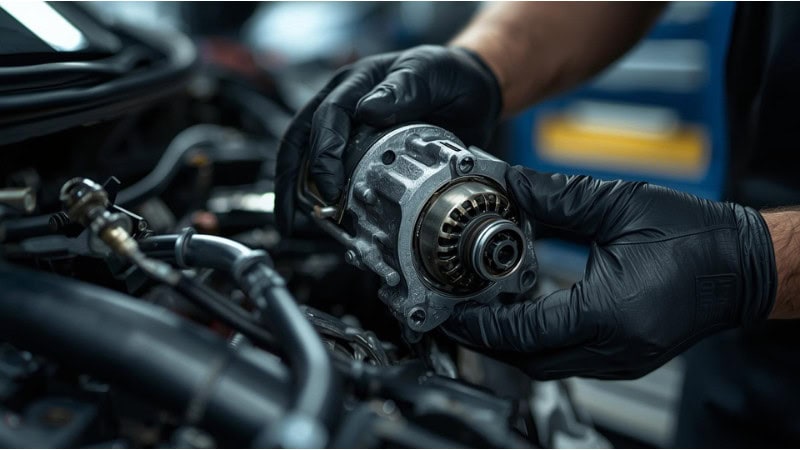
The starter is a powerful electric motor attached directly to the engine. Its job is to spin the engine’s main shaft, called the crankshaft, quickly enough so the engine can start running. When you turn the key or press the start button, an electrical signal is sent to the starter solenoid, which is like a switch built into the starter. The solenoid pushes the starter’s gear into place against a toothed wheel on the engine, called the flywheel, allowing electricity from the battery to flow to the starter motor. The motor then turns the crankshaft until the engine begins running on its own.
If the starter system isn’t working, your engine won’t turn over at all, no matter how good the battery or fuel system is. Starters draw a lot of electrical power and sit near hot parts of the engine, so their internal parts, such as small electrical contacts called brushes and supporting pieces called bearings, wear out over time. This can cause the engine to crank slowly or not turn at all.
Here’s an easy way to remember: the battery supplies power, the solenoid sends it to the starter, and the starter motor turns that power into engine movement.
Common Signs of a Bad
A failing starter often gives a warning before stopping completely. The most common sign is turning the key and hearing one click or nothing while the engine doesn’t move. If your dashboard lights stay bright but the engine won’t crank, the battery is likely fine, and the starter might be the problem.
If the engine cranks slowly with a fully charged battery, the starter may be weak. Grinding noises during starting indicate the starter gear isn’t engaging the flywheel. Don’t ignore this sound—it can cause bigger issues.
A weak starter might stop working when hot after a long drive, but work again when cooled. This usually means a starter problem. In rare cases, you might smell burning near the starter, showing it pulls too much power.
These signs don’t always mean the starter is definitely bad, but they’re strong clues that it’s time to test it.
Safety First Before Testing
Always put safety first when testing a starter. Car electrical work and being under the hood can be risky. Because the starter sits close to the engine and hot exhaust, let things cool before you begin. Always disconnect the negative battery cable to prevent sparks when checking connections or using a multimeter.
If you must lift the car, use jack stands—never only a hydraulic jack. Jacks alone aren’t safe, especially on uneven ground. Make sure you have good lighting so you can see the starter, wiring, and grounds clearly.
When testing voltage, avoid touching exposed metal with both hands. Starters use high current, and grounding can cause burns or short circuits. Gloves and eye protection add safety.
By preparing safely, you ensure accurate starter testing and reduce the chance of injury or damage.
Check the Battery Before Blaming the Starter
Before pointing fingers at the starter, test the battery first. A weak battery is the most common reason a vehicle won’t crank, and it can imitate every classic “bad starter” symptom. Using a digital multimeter, read battery voltage with the engine off. A healthy battery should be near 12.6 volts. If the reading is low or the voltage drops heavily when you turn the key, the starter may not be receiving enough power to operate.
Dirty battery terminals can also restrict current flow. Cleaning corrosion with a wire brush often restores strong cranking. Consider battery age, too—most U.S. car batteries last only 3 to 5 years, and older ones lose capacity quickly.
If the engine cranks normally with a jump-start, the problem is likely the battery or charging system, not the starter.

Inspecting Starter Connections and Wiring
After checking the battery, inspect the wiring to the starter. The main battery cable should be clean and tight, as corrosion or looseness can cut voltage and make a good starter seem dead. Also, check the smaller ignition signal wire on the solenoid. If loose, damaged, or heat-soaked, it may not send the crank signal.
Follow the wiring path and look for cracked insulation or melted spots, especially on vehicles where the starter sits close to exhaust heat. Also, inspect the engine ground strap. A weak or corroded ground can slow crank speed and create misdiagnosis. Cleaning both ends of the ground connection often restores full current flow.
These checks help rule out wiring faults before blaming the starter.
Voltage Drop Testing the Starter
A voltage drop test is one of the most accurate ways to diagnose a starter problem without removing the part. A voltage drop is a loss of electrical power as it travels through wires and connections. Starters require strong, clean voltage to operate. If the incoming power falls even slightly under load, the starter may crank slowly or not at all. To run this test, attach the positive probe of your multimeter (an electrical measuring tool) to the battery’s positive post, and the negative probe to the starter’s positive terminal. Have someone turn the key to crank. If the meter shows a voltage difference of over 0.5 volts, there’s excessive resistance somewhere in the power path.
Next, perform the same test on the ground side. Place the positive probe on the starter housing and the negative probe on the battery’s negative terminal. Again, crank the engine. If you see more than 0.3 volts, the ground path is weak.
These numbers matter because voltage drop hides inside wiring and connections. You may have a good battery and a strong starter motor, but if resistance builds along the circuit, the engine won’t turn. Voltage drop testing helps pinpoint wiring problems rather than blindly replacing expensive parts.
Bench Testing the Starter Motor
If voltage tests don’t identify the problem, the next step is to bench test the starter. Bench testing means removing the starter from the vehicle and directly supplying it with power with jumper cables. Clamp the negative (black) cable to the metal case of the starter, then touch the positive (red) lead to the starter’s solenoid terminal—all while making sure the starter is placed securely on the ground. A healthy starter should spin quickly and engage smoothly without grinding or hesitation.
This test helps you confirm whether the motor itself is mechanically sound. If the starter spins weakly on the bench, the brushes, armature, or solenoid may be worn out, and replacement is likely the best option. But if the motor performs strongly off the vehicle, the problem almost always lies in wiring, relays, or low battery voltage—not the starter itself.
Testing the Starter Relay
The starter relay connects the ignition switch to the solenoid. If it fails, you may hear a click under the hood or get no response when turning the key. To test, find the relay in the fuse box and check for identical ones nearby. Many U.S. vehicles use matching relays for the fuel pump or the AC. Swap them to confirm the relay function.
You can also test the relay for continuity with a multimeter. If there’s no continuity, or if the relay buzzes or overheats, it’s faulty. A bad relay can mimic a bad starter, so ruling it out saves time and money.
Starter vs Battery: How to Know Which One Is Failing
Drivers often confuse battery and starter failures because both cause no-crank. The fastest way to tell them apart is to watch the dash lights. If the lights stay bright and the radio works, but the engine won’t turn on, the battery likely has enough power, making the starter the main suspect. If the lights dim or go off, the battery is weak.
Another sign is crank behavior. A failing starter often produces a single click, repeated clicking, or complete silence, even with a charged battery. Meanwhile, a weak battery usually creates a slow, dragging crank sound.
Jump-starting is a strong clue: if the engine cranks normally with a jump, the battery or charging system is the issue—not the starter motor.
When Your Starter Is Definitely Bad
At some point, testing becomes confirmation. If the starter shows strong voltage reaching both the main terminal and the solenoid signal wire, yet the engine still won’t crank, the starter itself is likely bad. Grinding noises during start-up are another clear sign. That sound happens when the starter gear fails to fully engage the flywheel and begins chewing teeth. A burning smell or visible smoke from the starter area usually points to internal shorting, damaged windings, or a locked armature.
Heat can also cause failure. A weak starter may work cold but fail warm, then return when cooled—usually from internal resistance. If the bench test shows slow, uneven, or no movement, the starter needs to be replaced.
When multiple symptoms align, replacing the starter is the smartest fix.
Final Testing Tips and Common Mistakes to Avoid
Even with good tools and solid information, starter testing can go wrong if a few fundamentals are ignored. One common mistake is testing voltage with dirty terminals. Corrosion acts like a wall in the circuit, blocking amperage and creating false readings. Always clean contact points before you measure anything. Another error is testing the starter without letting the battery rest. If you’ve been cranking repeatedly, surface charge drops and voltage readings become unreliable. Give the battery a few minutes to recover.
Many DIY techs also forget to check the ground side of the circuit. They only look at power delivery and ignore the ground strap hiding under the engine brackets. A weak ground can mimic a dead starter every time.
Make sure you don’t condemn the starter too early. Starters rarely fail alone—bad relays, blown fuses, weak alternators, and poor battery cables all play a part. Take notes while testing, compare results, and don’t rely on sound alone.
FAQ
Q1 – Can tapping a starter really make it work again?
Sometimes tapping a starter with a small hammer or wrench can momentarily bring it back to life. The vibration causes worn brushes inside the motor to reconnect with the armature, allowing the starter to spin. But this is never a repair—only a temporary trick to move the vehicle or confirm internal wear. If tapping works, it almost always means the brushes, bearings, or solenoid are failing. Mechanics may use this method for diagnosis, not as a fix. Replace the starter soon to avoid being stranded.
Q2 – How long does a starter normally last?
Starters generally last between 80,000 and 150,000 miles, depending on driving habits and engine type. Trucks with large engines and short-trip vehicles may wear starters faster because they undergo more cranking cycles. Heat is another factor—starters mounted near exhaust components wear out sooner due to constant temperature stress. Regular battery health also matters. A weak battery forces the starter to work harder every time you crank the engine. With clean wiring and a strong voltage supply, starters can comfortably exceed their expected lifespan.
Q3 – Does cold weather affect starter performance?
Cold weather doesn’t directly damage the starter, but it affects everything around it. Engine oil thickens in low temperatures, making the starter work harder to rotate the crankshaft. Batteries also lose power in the cold, starving the starter of the amperage it needs. The combination creates slow cranking or no-crank symptoms even if the starter is healthy. Keeping terminals clean, using proper oil grades, and maintaining a strong battery reduce winter problems. If the starter struggles only during freezing weather, test the voltage before replacing anything.
Q4 – Can a bad alternator cause starter failure?
A bad alternator doesn’t directly damage the starter, but it indirectly reduces starter reliability. When the alternator isn’t charging correctly, the battery never fully recharges. That means the starter has to crank with low voltage over and over. Low voltage causes heat, stress, and longer crank time, wearing down brushes and solenoid contacts. Drivers may think the starter is weak, but the real issue is a lack of charging. Before replacing a starter, always check alternator output, battery voltage, and belt tension.
Q5 – Why does my starter click but not crank?
A rapid clicking sound usually means the starter solenoid is receiving power, but there isn’t enough amperage to turn the motor. That could be caused by a weak battery, corroded terminals, or poor grounding. A single heavy click often points toward internal starter failure or a locked engine. Test battery voltage first, then inspect cables and grounds. If the voltage is strong and the wiring is clean, the starter’s internal components may be worn. Clicking is one of the most common early signs of starter trouble.
Q6 – Can a bad ground stop a starter from working?
Absolutely. Starters rely on a clean ground path to complete the electrical circuit. If the engine ground strap is loose, rusty, or broken, the starter may crank slowly or not at all. Many “bad starter” diagnoses turn out to be ground issues, especially on older trucks where straps corrode under salt and mud. Testing the voltage drop on the ground side quickly confirms this. Cleaning ground connections with sandpaper often restores full cranking power. Always inspect the grounds before replacing expensive starter parts.
Q7 – Is replacing a starter difficult for beginners?
It depends on the vehicle. On many cars, the starter is located low on the engine and held by two bolts, making removal fairly simple. Trucks and SUVs, however, may require removing skid plates or exhaust components. The hardest part is usually accessing bolts and wiring safely. Using jack stands, disconnecting the battery first, and labeling wires make the job easier. If you’re comfortable with tools and follow a repair manual, DIY is possible. If bolts are rusted or access is tight, hire a mechanic.
Q8 – Should I rebuild a starter or buy a new one?
Rebuilding a starter can be cheaper, but it requires skill, access to parts, and time. Internal components like brushes, bushings, and solenoids must be replaced precisely. For most drivers, buying a new or professionally remanufactured starter is faster and more reliable. Modern starters are sealed, and rebuilding them without proper tools can shorten their lifespan. New units include updated components and warranties, making them safer in the long term. Rebuilding is best for classic cars or hobby projects; daily drivers benefit more from replacement.
Conclusion
Testing a starter doesn’t have to be guesswork. With the right steps—checking the battery, inspecting wiring, running voltage drop tests, and bench testing—you can pinpoint a bad starter the same way professional U.S. mechanics do. Most starter problems come from a weak electrical supply, not the motor itself, which is why careful diagnosis saves money and prevents replacing the wrong part.
If your readings show strong voltage, clean wiring, and a solid relay signal but the engine still won’t crank, the starter is likely worn out and ready for replacement. Knowing how to test first gives you confidence and helps avoid towing bills or unnecessary shop labor.
Following this guide gives car owners a reliable, realistic path to accurately and safely diagnose starter issues.
